
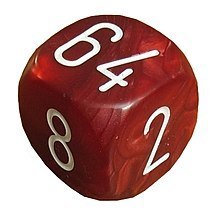
If you’ve just bought your first backgammon set, you may have noticed a strange die that looks nothing like the others. Instead of numbers from 1 to 6, it displays 2, 4, 8, 16, 32, and 64.
This special die is called the doubling cube.
What is it used for? How does it work? And when should you use it?
Backgammon-Rules tell you all you need to know about the doubling cube in backgammon.
Origin of the Doubling Cube
The doubling cube appeared in backgammon at the beginning of the 20th century, most likely in gaming clubs on New York’s Lower East Side.
No one knows exactly who introduced it, but today the doubling cube is considered essential for anyone who wants to experience the full strategic depth of backgammon. Without it, a large part of the game’s decision-making simply disappears.

What Is the Purpose of the Doubling Cube?
The doubling cube has one single function:
👉 to increase the stake of the game.
At the start of a game, the cube is placed on the side of the board showing 64, which means it has not been used yet. The game begins with a value of 1 point.
At any time during the game — before rolling the dice — a player who believes they have an advantage may offer to double the stakes.
To do so, the player:
- Takes the cube
- Places it in front of the opponent
- With the face 2 showing
Take or Drop: Your Opponent’s Choice
When a double is offered, the opponent has two options:
- Take: Accept the cube and continue playing.
The game is now worth 2 points instead of 1. - Drop: Decline the cube.
The game ends immediately, and the player who offered the double wins 1 point.
If the cube is taken, the accepting player now owns the cube and is the only one allowed to offer the next double (to 4, then 8, and so on).
Scoring With the Doubling Cube
At the end of the game, the winner receives the number of points shown on the cube.
That value is then:
- Doubled in case of a gammon
- Tripled in case of a backgammon
Because of this, doubling decisions often matter more than checker moves themselves.
The Crawford Rule
Backgammon is usually played as a match, where players race to reach a certain number of points (always an odd number, such as 7, 11, or 15).
The Crawford Rule states that:
- When a player is one point away from winning the match,
- The doubling cube cannot be used in the next game
This special game is called the Crawford Game.
If the match is not finished after that game, the cube returns to normal use.
The Jacoby Rule
In money games, players do not aim for a target score. Each game is played independently for an agreed stake.
In this format, the Jacoby Rule is usually in effect:
- Gammon and backgammon only count if the cube has been turned at least once
- If the cube was never offered, a gammon still counts as 1 point
The Jacoby Rule encourages earlier doubling and keeps money games fast and dynamic.
Learning When to Double (and When to Drop)
Knowing when to offer a cube — and when to take or drop — is one of the hardest skills in backgammon. Even top players make mistakes.
Cube decisions depend on:
- Race position
- Board strength
- Market value
- Risk of losing the cube opportunity
The best way to improve is simple: practice in real games.
Playing online allows you to experience common cube situations repeatedly:
- Free games on platforms like Backgammon Cash help beginners get comfortable with cube timing
- More competitive platforms like Nextgammon let you analyze cube decisions after each match
The more you play, the more natural doubling decisions become.
Final Thoughts
The doubling cube is what transforms backgammon from a simple race game into a deep battle of judgment and nerve.
Get used to using the cube early. Make mistakes. Learn from them.
That’s how every strong backgammon player improves.
Stay tuned for more strategy and equipment guides on Backgammon Rules.
May the dice — and the cube — be with you 🎲
I have been practicing with the doubling cube in mind. I think of real backgammon players who have won and lost fortunes like Omar Sharif the famous and great Egyptian actor.
I will endeavor to win more fortunes than lose.